


An East Hartford manufacturer's investment in additive manufacturing is protecting high-value components, reducing costs and demonstrating the value of bringing new manufacturing capabilities in-house.
When Watson Coburn, a quality control engineer at EBL Products, suggested investing in a 3D printer, Director of Business Development Russ Petrucci wasn't immediately convinced.
"When he first came to me and said we need a 3D printer, I said to myself, for what? I don't think like he thinks," Petrucci recalled.
For a company that has spent more than six decades manufacturing high-precision ceramic components, the value of 3D printing wasn't immediately obvious.
But Coburn saw an opportunity to solve a manufacturing challenge. He believed that designing and producing customized tools and fixtures in-house could improve how EBL's products were handled, reduce the risk of damage and lower costs.
With support from Connecticut's Additive Voucher Program (AVP) and CCAT, EBL invested in additive manufacturing technology and began turning that idea into measurable results.
Protecting Precision at Every Step
Based in East Hartford, Connecticut, EBL Products manufactures custom piezoceramic components used in medical, industrial, and scientific applications, including medical ultrasound, nondestructive testing, flow measurement, and sonar.
These specialized materials convert electrical energy into mechanical motion and vice versa, making them essential to technologies that rely on precise sensing and ultrasonic performance.
Unlike manufacturers producing standardized parts, EBL fabricates components to customer-specific requirements. With specialized products moving through multiple manufacturing and inspection stages, careful handling is essential to maintaining quality and protecting valuable parts.
One challenge involved the cleaning process. With components ranging widely in shape and size, EBL needed customized racks to hold parts during cleaning. Having these fixtures manufactured from high-density polyethylene (HDPE) could cost approximately $8,000 per size.
Today, EBL designs and 3D prints its own cleaning racks for approximately $30 to $50 per fixture, significantly reducing costs while gaining the flexibility to accommodate different component designs.
A Practical Application With Real Business Value
Additive manufacturing, commonly known as 3D printing, creates physical objects layer by layer from a digital design. Unlike conventional machining, which removes material to produce a finished part, additive processes build components by adding material only where needed.
The technology allows manufacturers to prototype designs and create customized tools, fixtures, and components without the lead time and expense often associated with traditional manufacturing methods.
At EBL, one particularly valuable application has been the development of custom 3D-printed carriers that protect delicate ceramic components as they move between workstations.
Coburn demonstrated the value of the technology by holding up one of the custom fixtures.
"There's $2,000 worth of parts in these holders," he said.
The fixture keeps the delicate components separated during handling, reducing chipping, breakage and scrap.
EBL has also developed custom shipping trays to protect finished components during delivery. The trays reduce packing time and help prevent damage in transit, providing an inexpensive way to safeguard valuable products. Customers have even expressed appreciation for the extra care EBL takes in packaging their orders.
For EBL, the opportunity was not about changing the products it manufactures. It was about improving the processes used to produce, handle and protect them, delivering practical operational benefits while maintaining the quality customers expect.
From Technology Demonstration to Investment
EBL's journey into additive manufacturing began at a demonstration hosted at CCAT's Advanced Technology Center in East Hartford. The event introduced manufacturers to industrial 3D-printing applications, including polymer-based and metal additive manufacturing technologies.
"When you're new to this, you know, CCAT was the guidance," said Petrucci.
EBL's experience demonstrates how CCAT connects manufacturers with technologies, expertise and resources that support informed investment decisions and build new capabilities.
In 2023, EBL received an AVP grant to support the purchase of a Markforged Onyx Pro 3D printer. The investment enabled the company to design, prototype, and manufacture custom solutions in-house.
Funded through Connecticut's Manufacturing Innovation Fund, AVP helps eligible manufacturers overcome financial barriers to adopting additive technology. CCAT also provides guidance to help manufacturers assess potential applications, evaluate technologies, and navigate the grant application process.
"The AVP program substantially eases the financial burden of making an investment in additive manufacturing. My team works diligently to help manufacturers navigate the application process and receive a timely determination regarding the level of financial assistance available to them." — Paul Striebel, Program & Procurement Manager
To date, AVP has provided nearly $500,000 in assistance to 34 manufacturers investing in 3D-printing technology.
From Investment to Measurable Results
What began as an engineer's proposal has become an in-house manufacturing capability with measurable value.
EBL reported saving approximately $10,000 over a three-month period by producing needed parts in-house. The company continues to identify new opportunities for savings as it takes on projects and develops additional applications through its internal research and development efforts.
By producing custom fixtures in-house, EBL can reduce its reliance on expensive metal machining while saving the time and labor associated with traditional fixture manufacturing.
One example involves long, narrow ceramic components that were difficult to secure during plating and other production steps. Using its 3D printer, EBL developed a custom fixture with two supporting racks connected by a post, allowing the delicate parts to be supported at both ends.
Beyond the financial savings, additive manufacturing has given EBL greater flexibility to develop customized fixtures, experiment with new designs, and respond to production challenges as they arise.
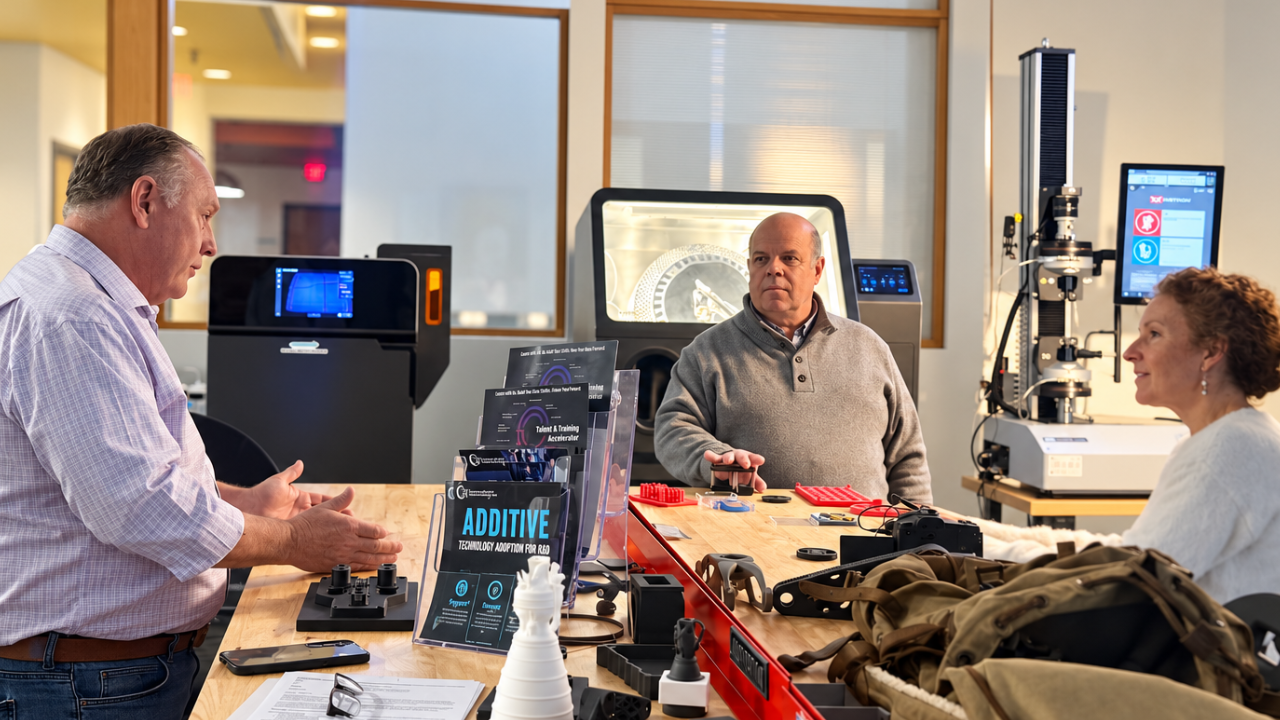
During a recent visit to CCAT's Additive Workflows Lab in East Hartford, Petrucci and Coburn shared an update on EBL's additive manufacturing journey. They also toured the lab to see where manufacturers receive hands-on training in additive technologies and workflows.
The visit brought their journey full circle, from an early introduction to additive manufacturing at CCAT to putting the technology to work in EBL's own operations.
Investing in Connecticut Manufacturing
EBL's experience demonstrates how innovation can begin with an idea from someone who understands a manufacturing process firsthand. With access to technology, expertise, and investment resources, that idea can become a new capability with measurable business value.
"What stands out about EBL is their willingness to rethink how work gets done. They identified a practical manufacturing challenge and turned an idea into a capability that's delivering measurable value across their business." — Amy Thompson, Ph.D., Chief Technology Officer
"This is what effective technology adoption looks like: connecting innovation with real business needs. EBL is setting a strong example for other Connecticut manufacturers," said Dr. Thompson.
EBL's investments in technology extend beyond additive manufacturing. The company has also used grant funding to purchase an automated measurement system for its Quality Control Department, to support its current and future inspection needs. Looking ahead, EBL is exploring additional opportunities through CCAT, including cybersecurity funding to support Cybersecurity Maturity Model Certification (CMMC) readiness as the company looks to expand its work in defense and other industries with stringent security requirements.
What began with Petrucci questioning the need for a 3D printer has become an example of how a focused investment can lead to lasting improvements. For EBL, additive manufacturing is now an established in-house capability, one that continues to solve production challenges, protect valuable components and create new opportunities for innovation.
Explore Additive Manufacturing With CCAT
Through the Additive Manufacturing Acceleration Program (AMAP), CCAT helps Connecticut manufacturers evaluate, test, and adopt additive manufacturing technologies. Funded by the Connecticut Department of Economic and Community Development (DECD), AMAP provides technical consultations, demonstrations, hands-on training, equipment loans, and funding opportunities.
One way manufacturers can get started is through the QuickStart Program. Eligible Connecticut manufacturers can borrow a 3D printer for four weeks at no equipment cost to test applications in their own facilities before investing. CCAT provides delivery, setup support, training, technical guidance, and pickup. Participants are responsible for material costs.
For manufacturers ready to invest, the Additive Voucher Program (AVP), available through AMAP, currently offers 1:1 matching grants of up to $50,000 for eligible additive manufacturing investments.
"The best starting point is a real production challenge. QuickStart gives manufacturers the opportunity to test additive manufacturing in their own operations, see where it adds value, and make more informed decisions about next steps. That might mean additional training, technical support, or a larger investment in the technology." — Oscar Montanez, Additive Adoption Lead
Interested in what additive manufacturing could mean for your business? Explore these resources to learn more.
Explore Additive Manufacturing With CCAT
Discover how CCAT works with manufacturers to evaluate, test and adopt additive technologies, including opportunities through the QuickStart Program.
Find Funding Opportunities
Explore Connecticut manufacturing grants that support investments in advanced technologies, including additive manufacturing.
Watch EBL's Additive Manufacturing Story
Hear directly from Russ Petrucci and Watson Coburn about EBL's experience adopting 3D printing and the value it has brought to their operations. Watch the video.
__________________________
About Voices of Innovation
Voices of Innovation spotlights manufacturers putting advanced technologies to work to improve operations, build capabilities and strengthen competitiveness. Through firsthand stories, the series explores the challenges, decisions and results behind technology adoption.

