


%20(7).png)
Guill Tool & Engineering, a precision manufacturer of extrusion tooling based in West Warwick, Rhode Island, operates in a high-mix, low-volume environment where tooling speed and responsiveness directly impact daily operations. As production demands increased, the team began taking a closer look at internal tooling and prototype lead times and how they could improve them.
Like many manufacturers, Guill Tool saw the potential of additive manufacturing. The question was not whether the technology was interesting, but whether it would work reliably within their existing workflows and production environment, and whether it could deliver consistent value beyond one-off use.
That question kicked off Guill Tool’s engagement with us at the Connecticut Center for Advanced Technology (CCAT), in collaboration with Polaris MEP, through the Regional Additive Manufacturing Program (RAMP). From the start, the focus was on guided adoption, combining hands-on training, technical evaluation, and financial support to help Guill Tool move forward with confidence.
“It gave us a structured, low-risk way to evaluate additive manufacturing and move beyond trial-and-error. With CCAT and Polaris MEP’s technical and strategic guidance, we were able to validate real applications, shorten tooling lead times, and establish additive manufacturing as a dependable in-house capability.”
— Robert Peters, General Manager, Guill Tool & Engineering
Building the Foundation Through Training
Before any equipment decisions were made, Guill Tool focused first on understanding what additive manufacturing could realistically support—and where it might fall short.
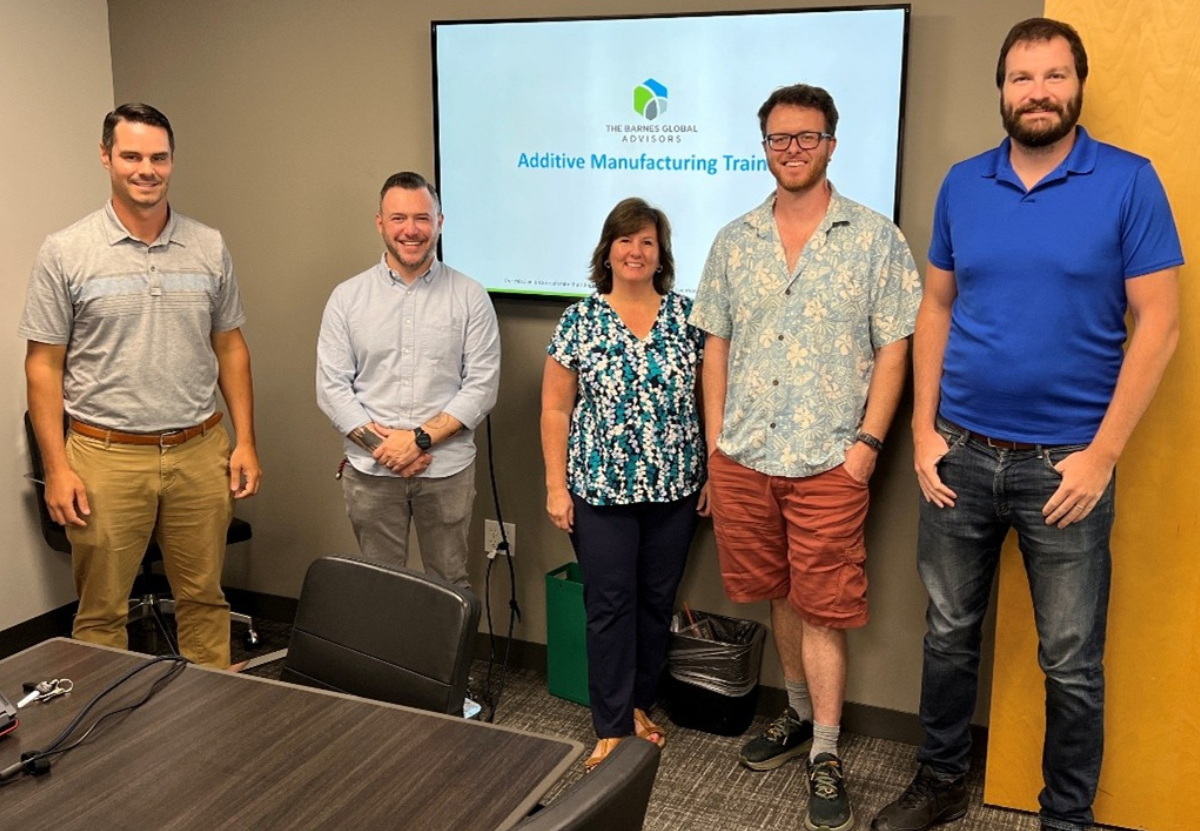
As part of the engagement, Zach Gibbons, CCAT’s Senior Technical Trainer, led hands-on additive manufacturing training in collaboration with Polaris MEP. The sessions centered on real-world tooling applications, materials, design considerations, and production-relevant use cases, helping the team understand the full breadth of additive manufacturing processes available.
While the technology itself was new in many respects, Guill Tool’s team approached additive with a practical, problem-solving mindset. Rather than simply asking whether a part could be printed, the focus shifted to understanding why additive made sense for a specific application and where it could create measurable value within existing workflows.
As Zach observed:
“It was clear they weren’t fully aware of the depth and breadth of additive manufacturing processes available, which made for a really visible learning experience. Even without that prior knowledge, they were already positioning AM as a problem-solving tool. I’ve always said to ask, ‘Why are we printing this?’ not ‘Can we?’ Seeing them approach the technology through that lens was refreshing and puts them in a much better position to add value through its application.”
That shift in thinking—asking why instead of can we—positions manufacturers to use additive not as a novelty, but as a strategic tool that solves real production challenges.
Evaluating the Opportunity on the Shop Floor
With a shared foundation in place, our technical and business development teams worked alongside Guill Tool to identify where additive manufacturing could deliver the most value.
Oscar Montanez, CCAT’s Additive Adoption Lead, and Emily Turcan, CCAT’s Business Development Manager, spent time on-site reviewing workflows, discussing tooling bottlenecks, and evaluating candidate parts. The goal was not to push a solution, but to listen, observe, and identify practical opportunities while also ruling out applications that were not a good fit.
This evaluation helped Guill Tool move from curiosity to informed decision-making based on engineering needs and operational realities.
Testing Additive Through a Low-Risk Trial
Rather than asking Guill Tool to commit upfront, CCAT supported a low-risk trial through its integrated additive adoption approach, giving the team the opportunity to test the technology in their own environment before making an investment.
Guill Tool used a loaner system to produce real tooling and fixture applications. CCAT delivered the printer, supported setup, and worked closely with the team to evaluate tolerances, surface finish, post-processing requirements, and how additive could fit into day-to-day operations.
This hands-on testing phase helped answer a critical question: could additive manufacturing function as a dependable, repeatable capability on Guill Tool’s shop floor?
From Validation to Investment
Once additive manufacturing was validated against real production needs, the remaining hurdle was investment risk.
Through RAMP, financial assistance helped Guill Tool move forward with equipment acquisition at a reduced cost. CCAT returned on-site to support installation and train the team, ensuring the technology was not just purchased, but fully integrated and ready for consistent use.
What started as exploration became an in-house capability.
Results: From Experimentation to Capability
By following a guided, step-by-step approach, Guill Tool moved additive manufacturing from occasional experimentation to a reliable internal resource.
The results included:
- Reduced tooling and prototype lead times
- Less machining labor and material waste
- Increased production flexibility
- More consistent, in-house use of additive manufacturing
- Reduced reliance on external suppliers
Most importantly, decisions were based on real testing and experience, not assumptions.
Looking Ahead
With additive manufacturing now established internally, Guill Tool is exploring additional materials and systems, including high-temperature filaments and metal-based solutions, to continue expanding capability.
An ongoing casting project identified during the engagement is also being evaluated using additive-enabled approaches, with the potential to improve consistency while reducing lead times.
A Guided Path to Innovation
Guill Tool’s journey shows what’s possible when manufacturers have access to the right mix of technical expertise, hands-on training, and financial support.
By combining all three, CCAT and Polaris MEP helped Guill Tool evaluate, validate, and adopt additive manufacturing in a way that aligned with real operational needs and long-term goals.
Interested in exploring additive manufacturing for your operation?
Learn more about available training, technical guidance, and support by contacting us at ccat.us/contact
-------------------------------
About Voices of Innovation
Voices of Innovation spotlights leaders across the region’s manufacturing ecosystem who are embracing technology adoption and workforce training to drive performance, innovation, and growth. Through first-hand insights from our partners, we share the real-world impact of digital transformation and how companies are preparing for the future of advanced manufacturing.

